Destinations
- Pinnawala
- Dambulla
- Sigiriya
- Polonnaruwa
- Anuradhapura
- Matale
- Kandy
- Peradeniya
- Nuwara Eliya
- Ella
- Yala
- Tangalle
- Mirissa
- Galle
- Hikkaduwa
Day 1
Warmly welcome you at the Bandaranayke International Airport. Then begins the journey to Pinnawala
Elephant Orphanage, Take breakfast at Pinnawala. Following this, you will drive to Dambulla and check-in at your hotel. Sightseeing the city and proceeding to the Dambulla Cave temple. Overnight stay in Dambulla.
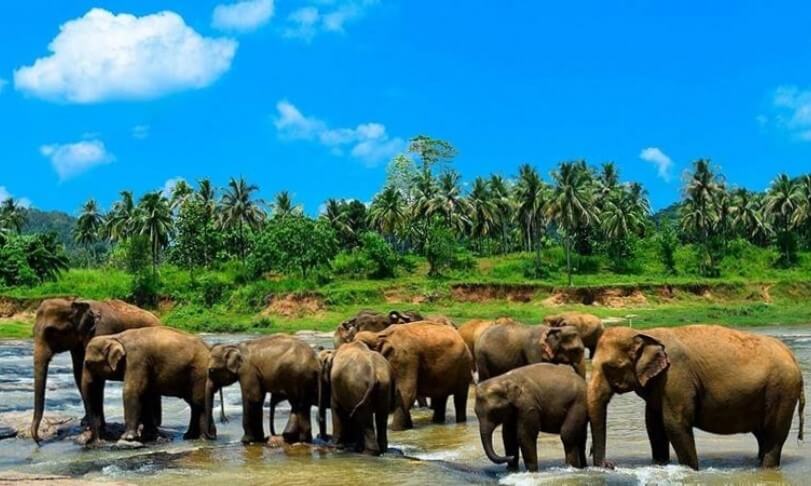
Pinnawala Elephant Orphanage
Established in 1975 with five orphaned elephants in an area of 25 acres of land at Pinnawala. Pinnawala is notable for being the largest herd of captive elephants in the world. There were nearly 90 elephants. The Orphanage which serves as a conservation and breeding centre as well as a place of informal education on elephants and their conservation is a world-famous attraction due to its unique way of maintaining such a large free herd of jumbos. Around 9:15 a: m starts feeding Baby Elephants and fruit feeding get their milk. The Elephants Parade to the river to Barth around at 10:00 a:m to 12:00 noon Head returns from the river. Following this, you will drive to Dambulla and check-in at your hotel. Sightseeing the city and proceeding to the Dambulla Cave temple.
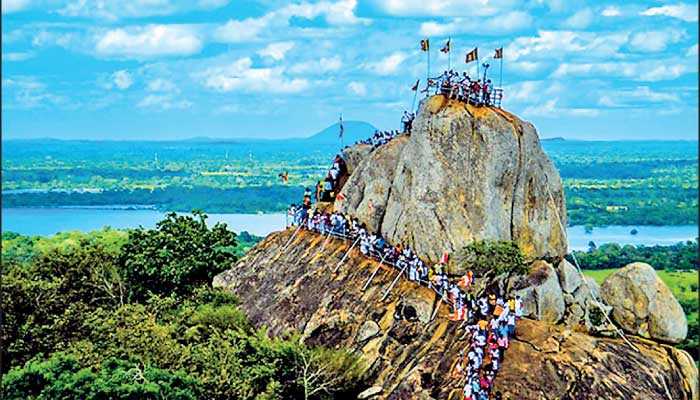
Dambulla cave temple
Dambulla is a commercial town with Sri Lanka’s largest produce vegetable market and is most famous for the cave temple and also for the iconic golden temple. Dambulla heritage site with a history extending from prehistoric and proto-historic times, right down to the modern period, makes Sri Lanka’s heritage really splendorous, Sightseeing the city and proceeding to the Dambulla Cave temple. It is believed that king VattaGamini was fleeing from his enemies in the1st century BC.

Day 2
After breakfast, we started climbing the Sigiriya lion rock. After Bullock cart riding to see Sri Lanka, Optional real rural Ayurveda massage. We drive to the Elephant riding place. You can decide to take an elephant ride on Through the Jungle. After that, we proceed to Polonnaruwa. Overnight stay in Dambulla
Sigiriya (Lion’s rock)
Sigiriya (Lion’s rock) is a wonderful ancient palace built atop a 660 feet high rock column. This wonderful rock castle is a creation of King Kassapa (477-495CE). He built his Palace on the top of this rock and decorated its sides with colourful frescoes. The painting woods have covered most of the western face of the rock. An area is 140 meters long and 40 meters high. There are references in the graffiti to 500 ladies in these paintings However, most have been lost forever. Sigiriya is one of the most attractive historical sites in Sri Lanka and it is most famous for its stunning frescoes. Sigiriya today is a UNESCO-listed world heritage site. We start climbing the rock. After we are back from the top of the rock.

Polonnaruwa
Polonnaruwa alias Pulastipura is an ancient city that was home to Sri Lanka’s second Kingdom. When the Anuradhapura Kingdom fell to South Indian invaders in 993, the Sinhalese royal capital was relocated to Polonnaruwa as the second capital of Sri Lanka. Polonnaruwa was also the royal capital of the south Indian Chola dynasty but they were warded off in 1070 by King Vijayabahu (1) and then he kept Polonnaruwa as his capital. But it is known as one of the cleanest and more beautiful cities in the country. The green environment, amazing ancient constructions, Parakrama Samudra (a huge lake built in 1200)Today the ancient city of Polonnaruwa remains one of the best planned archaeological relic cities in the country, standing testimony to the discipline and greatness of the Kingdom’s first rulers. The ancient city of Polonnaruwa has been declared a World Heritage site by UNESCO.
Day 3
After breakfast, transfer to Mihinthale. After that, we proceed to the Ancient city of Anuradhapura and check-in at your hotel. Overnight stay in Anuradhapura.
Mihintale
Mihintale is a sacred place of much historical and religious importance where the earliest introduction of Buddhism to Sri Lankans took place in 247 BC. The site contains a range of mountain peaks, a Vihara complex with dagobas, and ruins of monuments and structures. It was at Mihintale that Buddhism was introduced to Sri Lanka by Arhat Mahinda son of the great Buddhist emperor of India, Ashoka. When Arhat Mahinda visited Missanka Pabbata, the main mountain peak at Mihintale on the Poson full moon Poya day. King Davanampiyatissa the ruler of Anuradhapura, was on a hunting expedition pursuing a stag, having lost track of the stag, He saw the Arhat dressed in yellow robes sitting beneath the tree. Then Arhat met the King and then he introduced himself to the king and then he went on to test the king’s wisdom. Being satisfied with the king’s wisdom, Arhat Mahinda preached Dhamma to him. After embracing Buddhism; the king built a temple complex including 68 caves for Bhikkhus to reside in. After we proceed to Anuradhapura
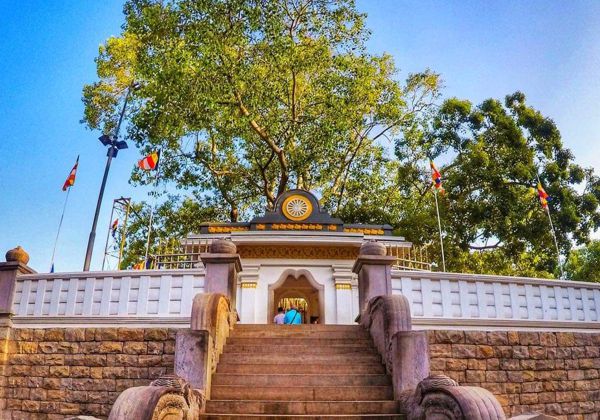
Anuradhapura- Sri Maha Bodhi
Anuradhapura- Sri Maha Bodhi, the oldest historically documented tree in the world, the Brazen Palace, Dagobas, Ruwanwelisaya, Abhayagiri & Jetawana Monasteries, finely preserved rock-cut statues of Lord Buddha and ruins of palaces, Isurumuniya rock temple.
Anuradhapura
Anuradhapura is an ancient city which as Mahavamsa, the great chronicle affirms, was founded in 380 BC by Prince Pandukabhaya. It remained the capital of Sri Lanka for about 1400 years and is the oldest city of Sri Lanka. Anuradhapura is bestowed with a plethora of historical monuments such as colossal dagobas, monasteries, temple complexes, palaces and many more amazing structures, and hundreds of huge reservoirs. Famous for its well-preserved ruins of ancient Lankan civilization. From the 4th century BC, it was the capital of Sri Lanka until the beginning of the 11th century AD. A World Heritage Site declared by UNESCO, Anuradhapura is one of the most sacred cities in Sri Lanka
The ancient city, considered sacred to the Buddhist world, is today surrounded by monasteries covering an area of over sixteen square miles (40 km).
Day 4
After breakfast proceeds to the Aukana Buddha statue, Ritigala Mountain. And check-in at your hotel. Overnight stay in Habarana.
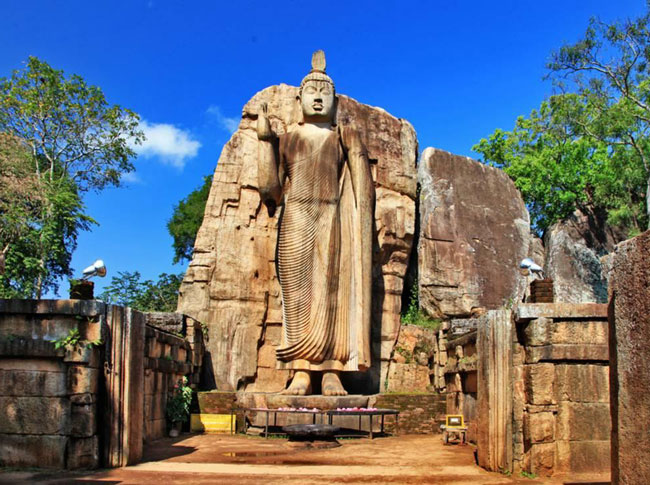
Aukana
Aukana Buddha statue is lying west of the famous serene Kala Wewa in kekirawa and was erected during the reign of King Datusena in the fifth century AD, this is a colossal standing image of Buddha hewn out of a boulder. The magnificent Avukana image stands 42 feet high.
Ritigala Mountain
After that, we proceed to Ritigala. Ritigala is an ancient Buddhist monastery and mountain in Sri Lanka. The ruins and rock inscriptions of the monastery date back to the 1st century BCE. It is located 43 km (27 mi) away from the ancient monastic city of Anuradhapura. Ritigala mountain range, a 1,528 ha (3,780 acres) Strict Nature Reserve, in the Dry Zone of Sri Lanka, is managed by the Department of Wildlife of Sri Lanka together with the Forest Department of Sri Lanka.At 766 m (2,513 ft) above sea level, and 600 m (2,000 ft) above the surrounding plains, Ritigala is the highest mountain in northern Sri Lanka.
Day 5
After breakfast, proceed to the Kandy En-route where you will visit the aromatic Spice Garden, Nalanda Gedige, Matale Aluvihara Rock temple and Matale Muthumariamman Hindu kovil. Thereafter proceed to the beautiful and historical city Kandy and Check-in your hotel. Overnight stay in Kandy
Spice Garden
Matale is situated in the central province in close proximity to Kandy. This area is very famous for its spice which is considered to be the best on the island. Gardens are open to visitors and its atmosphere is superb to stroll in fragrant greenery and learn more about the spices. The spice gardens attract tourists as well as locals who visit this area. These spices are used for culinary, cosmetic, and indigenous medicinal purposes. Entrances to these gardens are free and children could learn about the origin of spices and identify each spice by its individual fragrance.
Nalanda Gedige
Nalanda Gedige is considered one of the best gediges in Sri Lanka .A Gedige is a hollow structure with thick walls. This 8th –century gedige which lies in a raised ground in paddy fields, picturesquely surrounded by low hills and wooded hemlets, consists of a mandapa, an entrance hall, a short passage to a bare cello, and an ambulatory. Finely decorated faced sections and mandapa seem to be of South Indian style. However, there are no signs of Hindu deities in gedige which is said to have been used by Buddhists.
Matale Aluvihara
Matale offers you several attractions from heritage sites to natural attractions. Matale Aluvihara Rock temple is the place where Buddhist monks wrote the Buddhist scriptures (Tripitakas) in Pali on Ola leaves. There is an influx of tourists both home and abroad flocking to this historic temple.
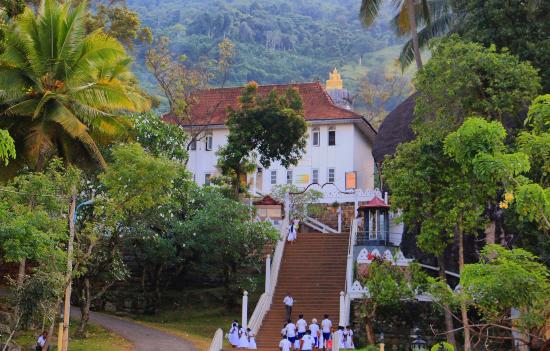
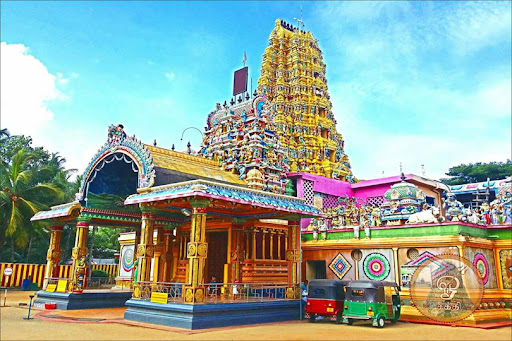
Matale Muttumariyamman Hindu kovil
Matale Muthumariamman Hindu Kovil, Muthumariamman Temple or Arulmigu Sri Muthumari Amman Kovil is a temple in Matale, Sri Lanka. The prefix “Muthu ”, literally means”pearl “. “Mari” means rain and “Amman” means mother. On completion proceed to a historic sacred city in Kandy.
Kandy
Sri Lanka’s second largest city after Colombo, 1551 above sea level, Kandy is a historic city of the highest religious and cultural importance. The last capital of Sinhalese King until it fell into the hands of the British in 1815, Kandy which is also known as Senkadagalapura was established by the Wickramabahu 111 (1357-1374 CE). Kandy remains the most sacred Buddhist since it is the home of the temple of the Sacred Tooth Relic (Sri Dalada Maligawa)- the most venerated Buddhist shrine in the world and this historic sacred site was declared a world heritage site by UNESCO 1988.
Day 6
After breakfast, we will visit the beautiful Dalada Maligawa in Kandy, the Temple Of The Sacred Relic of the tooth of Gautama Buddha. You will enjoy a city tour of Kandy, which includes the Upper & Lower Lake Drives, a Gem Museum, the famous Kandy Market, Emabakka devale, and some awe-inspiring Buddha Statues, amongst other very interesting sights. Following this, you will really enjoy a Cultural Dance Program. Overnight stay in Kandy.
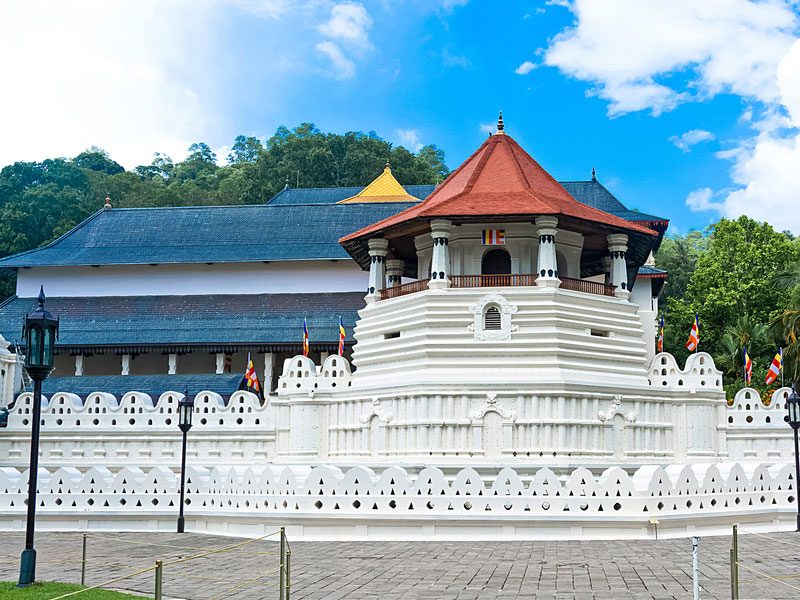
Dalada Maligawa
Temple of Tooth, Sri Dalada Maligawa, or the Temple of the Sacred Tooth Relic is a Buddhist temple in the city of Kandy, Sri Lanka. It is located in the royal palace complex of the former Kingdom of Kandy, which houses the relic of the tooth of the Buddha. The most sacred place of Buddhist worship in Sri Lanka and perhaps the world’s most sacred Buddhist shrine is venerated by millions of Buddhists all over the world. The temple of the Sacred Tooth Relic or Dalada Maligawa is a monumental palace built in the heart of the city of Kandy to house the sacred relic of the tooth of Gautama Buddha. Brought from Kalinga in India during the reign of Sri Meghavanna.
The sacred relic of the tooth was taken from the funeral pyre of Gautama Buddha in 483 BC. Later on, the princess Hemamali with her husband prince Danta smuggled it into Sri Lanka hidden in her hair on the instructions of her father Guhasiva a during the 4th Century AD and it was first enshrined in Isurumuniya Temple in Anuradhapura. The first established kingdom in ancient Sri Lanka. Then it moved through a number of kingdoms across the country from time to time and in the end, it was brought to Kandy by Hiripitiya Diyawadana Rala and Devanagala Ratnalankara Thera. during the reign of king Wimaladharmasuriya 1(1591-1604)who built a two-story building to place the sacred relic of the tooth. After that, it was improved by various kings who ruled the Kandyan kingdom, and the last improvement was done by King Sri Wikrama Rajasinha (1798-1815).
Embekka Devale
Embekka Devale is world-renown for its wood carvings, Embekka Devale is an ancient shrine built by King Wickramabahu 111 during the Gampola era (AD 1357-1374). Dedicated to the God Skanda. The devale is comprised of three sections viz. Sanctum of Garagha, Dogge (dancing hall), and Hewisi Mandapaya (drummers hall).Impressive wood carvings on ornate pillars of the drummers’ hall catch visitors’ eye.
Day 7
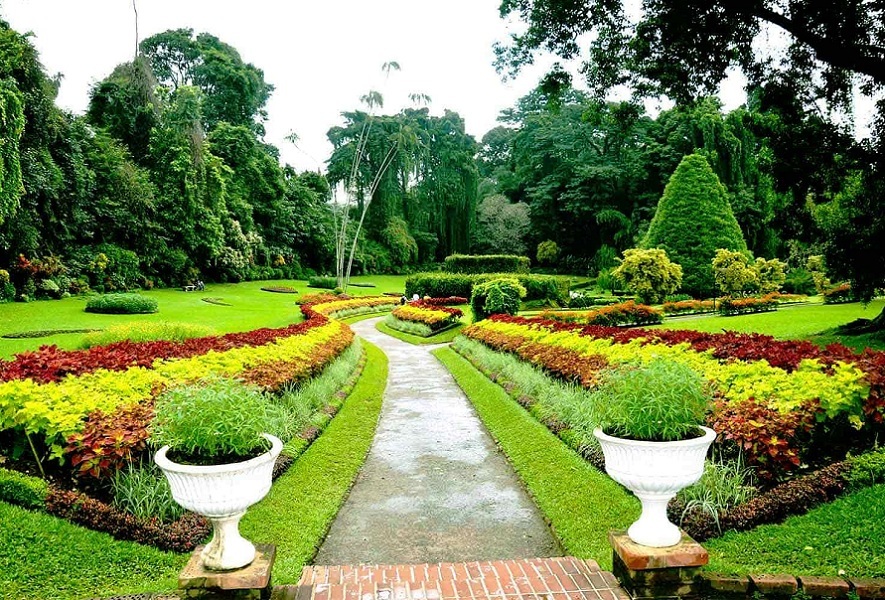
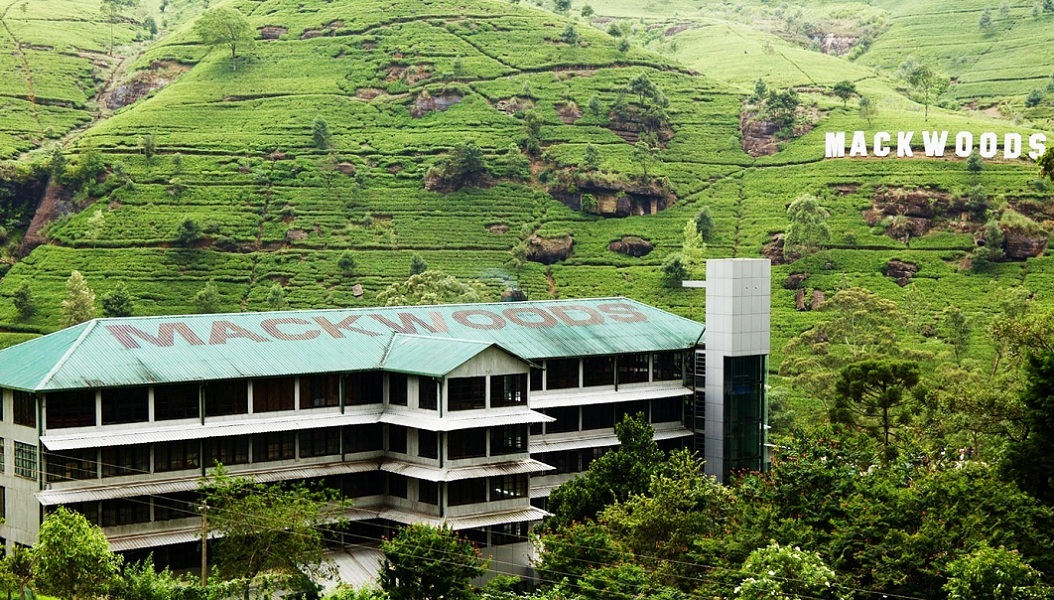
After breakfast, a visit to the Peradeniya Botanical garden, after driving around the mountains, viewing endless tea plantations and ramboda waterfalls, brings you to Nuwara Eliya, Sri Lanka’s “Little England” where time seems to have stood still since the days of the British occupation. On the way to Nuwara Eliya, you will visit a typical Tea Factory & enjoy a cup of tea. Following this, you check in to your hotel. After that, you will enjoy a City Tour of Nuwara Eliya. Overnight stay in Nuwara Eliya.
Peradeniya Botanical Gardens
The Royal Botanic Gardens at Peradeniya occupies a horseshoe-shaped peninsula and the scenic splendor of the garden has been raised to greater heights by the longest river of Sri Lanka, The Mahaweli which flows through its fringes. The total area is 147 acres (about 60 hectares) containing about 4500 plant species. It is situated in the serene hill capital; it is near the Mahaweli River. It is renowned for its collection of orchids.
Nuwara-Eliya
Nuwara-Eliya is one of the cities that lie at the highest altitude of Sri Lanka and is popular as a paradise holiday destination. Located in the central hills, 180km away from Colombo; Nuwara Eliya is a classic example of the climate diversity of Sri Lanka. It is also a city where the influence of Colonial architecture is visible. Covered and cornered from three of the highest mountains of the country are Piduruthalagala, the Great Western & Haggala, which t become a paradise of its own isolating itself from other bustling cities and towns. However, it offers many activities for tourists such as hiking, pony riding, boating, golfing, visits to the tea plantations, and the lovely landscapes & parks.
Day 8
After breakfast we leave to nanuoya railway station start short journey by train to Ella .Ella is blessed with some of the most beautiful views, you could find in Sri Lanka. Some of the places you could see in the Ravana Ella Falls, Little Adam’s Peak and Nine Arch Bridge among the other many stunning scenery. And Check in your hotel. Over Night st
Ella
Ella is a small village of quaint beauty, safely tucked-in amidst the towering peak of Sri Lanka’s central highlands of the Uva province. The sleepy village is nestled in a valley peering straight through Ella Gap to the plain nearly 1000m below and across to coastline, where on a fine day, you could even catch a glimpse of the Great Basses lighthouse of Southern Sri Lanka.If the view alone wasn’t good enough, Ella is a also surrounded by hilly countryside perfect for walks’, through tea plantations to ancient temples and waterfalls.
Little Adams Peak
Little Adams Peak whether considering the word ‘Little’, it is named after the sacred Adams Peak (Sri Pada –where the foot print of Lord Buddha is preserved) regarding the similarity between the two mountains. Therefore the mountain was called as Little Adams Peak.“Punchi Sri Pada” is another name for this peak. It is 1141 m in height. Little Adam’s Peak attracts many travelers who come to Sri Lanka. Gradually with an easy hike up to the mountain of Little Adams Peak you can consummation a worth panoramic view. You have to walk through lush green tea plantation. The journey is truly amazing and unforgettable and more amazing moments Wonderful trekking.
Nine Arch Bridge
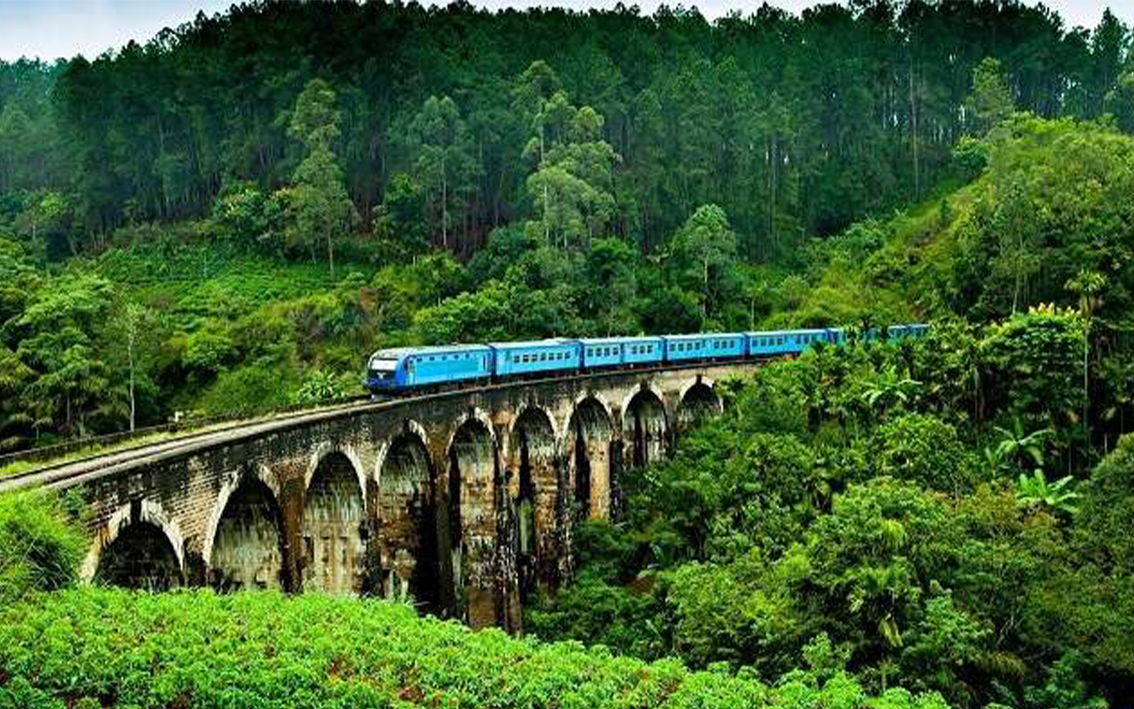
This viaduct was built at Gotuwala between the two railway stations – Ella and Demodara during the British Colonial period are the largest in Sri Lanka. Located almost 3100 feet above sea level, this 99.6ft high bridge is called “Ahas namaye palama” (Nine skies bridge) in Sinhala. When one stands underneath it and looks up there is a beautiful sight of ‘nine skies’ through the nine arches, This Bridge is also called ‘The Bridge in the sky due to the sheer height. The bridge was finally commissioned in 1921. Locals came forward and built the bridge with solid stone bricks and cement without steel.
Day 9
After breakfast proceed to Tissamaharamaya visiting Ravana water falls, check in at your hotel. Afternoon enjoy yala safari. Overnight stay in Tissamaharamaya.
Yala National Park
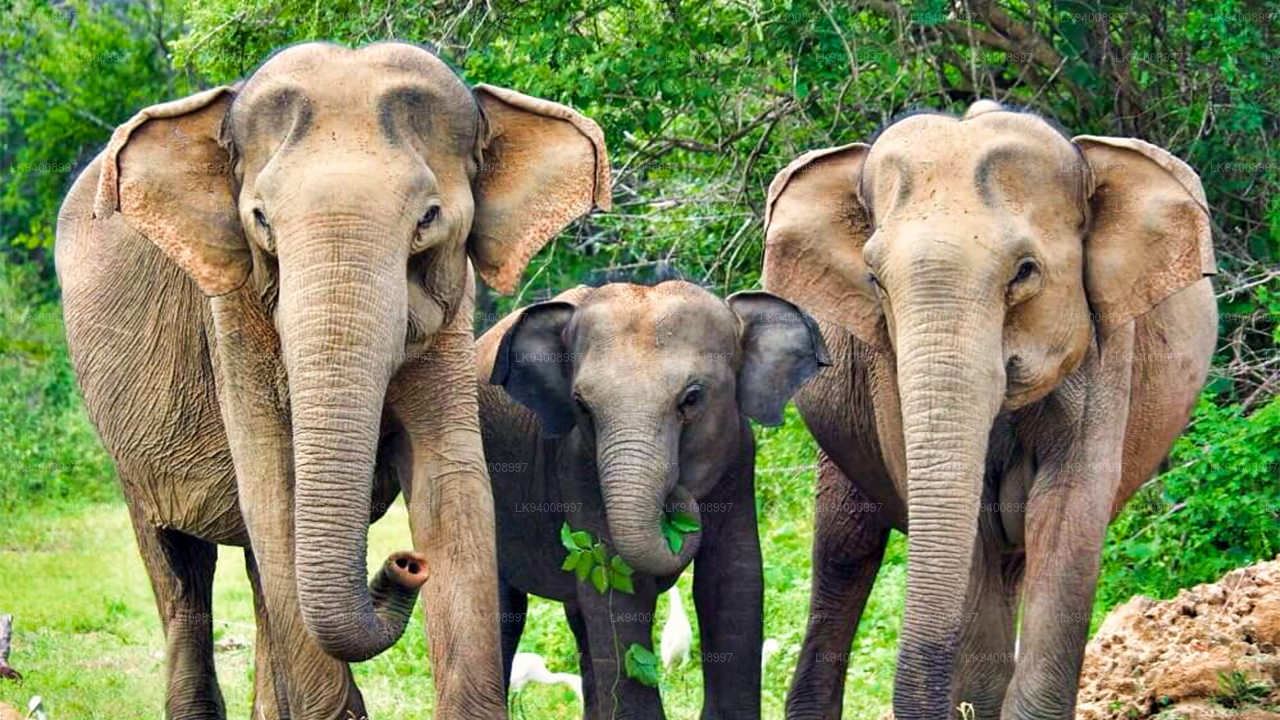
Yala National Park is a second largest national park in Sri Lanka. Yala or Ruhunu National park is one of the best and most popular parks in the country due to its diversity and density of the mammals. It consists of five blocks covering area of 97,881 hectares. Much of the reserve is parkland, but it also contains jungle, beaches, freshwater lakes and rivers and scrubland. The latter zone is punctuated with enormous rocky outcrops. The range of habitats give rise to a good range of wildlife.Yala has the world’s highest concentration of Leopards, although seeing this largely nocturnal carnivore still requires some luck. There are good numbers of Asian Elephants, Crocodile, Wild Boar, Water Buffalo and Grey langurs amongst other large animals. The open parkland attracts birds of prey such as White-bellied Sea Eagle and the wetlands have Waders, Painted Storks, and the rare Stork. Land birds of course are in abundance, and include Blue Faced Malkoha, Indian Peafowl and Sri Lanka Jungle fowl etc .Following this a scenic drive along the southern coast brings you Mirissa.
Day 10
After breakfast proceed to Tangalle .Check in your hotelwe visit to kalametiya Bird Sanctuary Rekawa lagoon, and Ussangoda. Overnight Tangalle.
Kalametiya bird Sanctuary
This is a haven for many species of residents as well as migrant water birds including many species of migrant ducks. The area is protected as a sanctuary by the Department of wildlife Conservation and is 712 hectares in extent. The area is primarily covered with reed beds, water bodies, and grass fields, marshes etc.
Rekawa lagoon
Rekawa is essentially an eco-friendly destination with a long sandy beach and a mangrove-skirted lagoon. The lagoon together with the area around is rich in biodiversity; it holds mangrove forests, vegetations and a wide variety of wildlife and birdlife Rekawa Lagoon is a comparatively small coastal lagoon with a water surface area of 2.4 km (0.93 sq mi).
Ussangoda
Ussangoda is a patch of high ground by the sea and spreads over a significant area. There are several legends related to the area. The site is considered a sacred / forbidden ground for general affairs in local lore. One popular belief is that Ussangoda is a ground of the local demi-god “Mangara”. Other beliefs range from religiously rooted backgrounds to the unwritten/alternate history related to Ravana. According to Hindu puranas, Ussangoda was one of the landing strips of Ravana’s Pushpaka viman There are many folk stories related to this site which include different takes about the land. General belief is that it is a part of a meteor or a proximity to a meteor hit. The main rationale for this belief is the soils brick-like hard quality with a reddish colour which is unique to this patch of land. Some rocks and soil layers contain what some speculate to be remnants of an extreme heat (that can be caused by an event such as a meteor hit). It is also suspected that the soil has a high concentration of minerals/metals giving its unique colour. In several places, especially by the sea facing areas rocks and soil can be observed clearly having multiple layers usually with distinct colorization. It is however unclear whether these speculations have been tested in any proper scientific study at all. It can be also noticed that Ussangoda is located geographically closer to another archaeological site “Miniha Gal Kanda”, where evidence for pre-historic human existence has been found.
Day 11
After breakfast proceeds to kalametiya Sanctuary visiting Rekawa lagoon, Blowhole, and Ussangoda. After that, we left for Marissa. Mirissa is a small rocky beach that is calm, relaxing, and almost private located nearby Weligama Bay. Whale and dolphin watching, Surfing are some of the activities you could do while being in Mirissa. And check-in at your hotel. Overnight stay in Mirissa
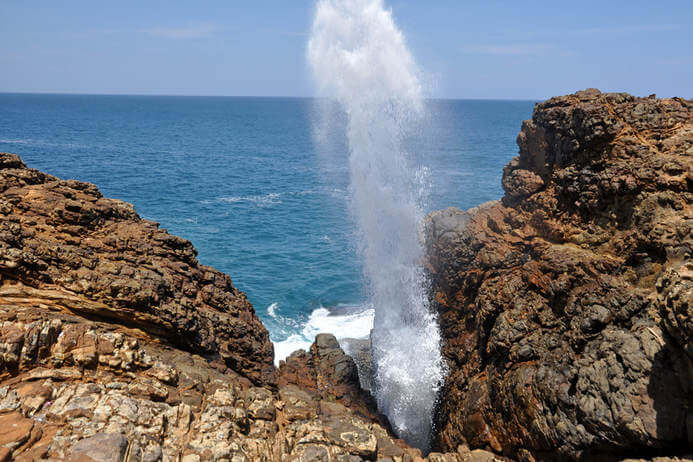
Blowhole or Hummanahaya
Hummanaya is a natural blowhole and caused when seawater rushes through a submerged cavern and is pushed upwards. The seawater flows underneath the shore and then comes out of this hole due to pressure. The water fountain created by the geological feature shoots up every couple of minutes, depending on the nature of the sea, with the spray often reaching as high as 25-30 m.
Day 12
Early in the morning, we will visit dolphins and whale watching. After that, we visit the Martin Wickramasinghe Folk Museum, Galle Dutch Port, and proceed to Hikkaduwa.
Check-in at your hotel. Overnight stay in Hikkaduwa.
Dolphin and whales watching
Mirissa is the best place you can go for whale and dolphin watching in Sri Lanka. In the warm Indian Ocean you can see Blue whales, Bryde’s whales, sperm whales, fin whales, and killer whales occasionally, and common dolphins, bottlenose dolphins, spinner dolphins, Risso’s dolphins, and striped dolphins. And also you can see the turtles and the various fish species like bluefin tuna and flying fish. The best seasons for whale watching start in November to April. The morning session will start at 6.30 am and normally the total trip duration is 5.6 hours, it will depend on sea conditions. Meals and bottles of water are provided by the organizers and usually travel 9-15 nautical miles per journey.

Martin Wickramasinghe Folk Museum
The house of Martin Wickramasinghe, one of the greatest novelists of Sri Lanka, has now turned to be a folk museum. Surrounded by a restored ecosystem comprising of hundreds of varieties of indigenous trees and shrubs in which birdlife abounds, this folk museum is essentially a repository of artifacts depicting the history of Sri Lankan folk culture, from ancient to modern times in order to remind the people of Sri Lankan folk culture, from ancient to modern times in order to remind the people of Sri Lanka of their living rooms. There are a number of items that exhibited which represent the folk history of Sri Lanka. Muppets, Masks, and Folk civilization are well demonstrated in this place and a superb place to grab more knowledge at once. It is something never missed by travelers.
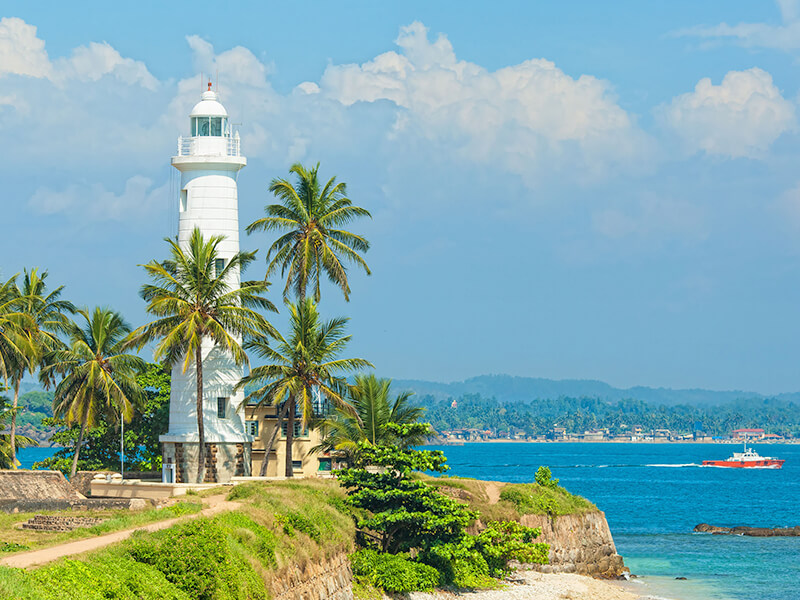
Galle Fort
En route to hikkaduwa we visited Galle Fort. The port of Galle is a centuries-old historic port in Sri Lanka. The history of Galle dates back to the 14th century, it was the ancient seaport of Tarshish and King Solomon used it to draw valuables like elephants, peacocks, gemstones. Persians, Arabs, Greeks, Romans, Malays, Indians, and Chinese have also used the Galle seaport for their business activities during the 14th century. The Galle seaport has played a pivotal role in the exportation of spices especially cinnamon from Sri Lanka in early 1400 BC.1505 Portuguese navigators arrived in Galle Port in 1505 with Lourenco de Almeida and the Dutch arrived in Galle in 1640.
Galle port, covering 52 hectares of land, is one of the busiest places in Galle with a multi-ethnic population living within its walls. Walk around the old town and the ramparts; visit the Maritime Museum, CountrySide Temple, Antique shops, CountrySide Mosque, and the many hotels and restaurants around. Enjoy the beautiful view of the Indian Ocean over the fort walls.
Hikkaduwa
Hikkaduwa is a small coastal town in the south situated 99 km south of Colombo a. Well-known for its beach, subaqueous world of coral gardens with shoals of brightly colored fish, and nightlife, Hikkaduwa is one of the most popular tourist destinations in Sri Lanka the coral sanctuary replete with colorful fish quite fascinating and you can explore these fantasies in a glass-bottomed boat or by diving. This is also a better place for sunbathing, snorkeling, board-surfing, and many other pastimes. One of the great attractions among worldwide travelers. A surf point perfect snorkeling locations with gold.
Day 13
After breakfast, spend your time leisurely on the beach. Enjoy glass-bottomed boats, diving and snorkeling. After that, we visited the Mask Museum at Ambalangoda. That you are at the end of your journey with us. Stay and relax at Hikkaduwa.

Day 14
Rest and departure airport We will comfortably take you to the international airport well in advance for your departure flight.